
Can You Build an ADU in Fairfax County? The 2026 Zoning Rules Explained
Regulations last verified: July 2026
Fairfax County doesn’t call them ADUs. They call them Accessory Living Units, or ALUs. And if you’ve ever tried to read the county’s zoning ordinance to figure out whether you can build one on your property, you know the experience is somewhere between reading a tax code and assembling IKEA furniture in the dark.
This guide cuts through the bureaucratic language and gives you what you actually need to know: the size limits, the setback rules, the lot requirements, and the step-by-step permit process for building an ADU in Fairfax County in 2026.
What Fairfax County Allows (and What It Doesn’t)
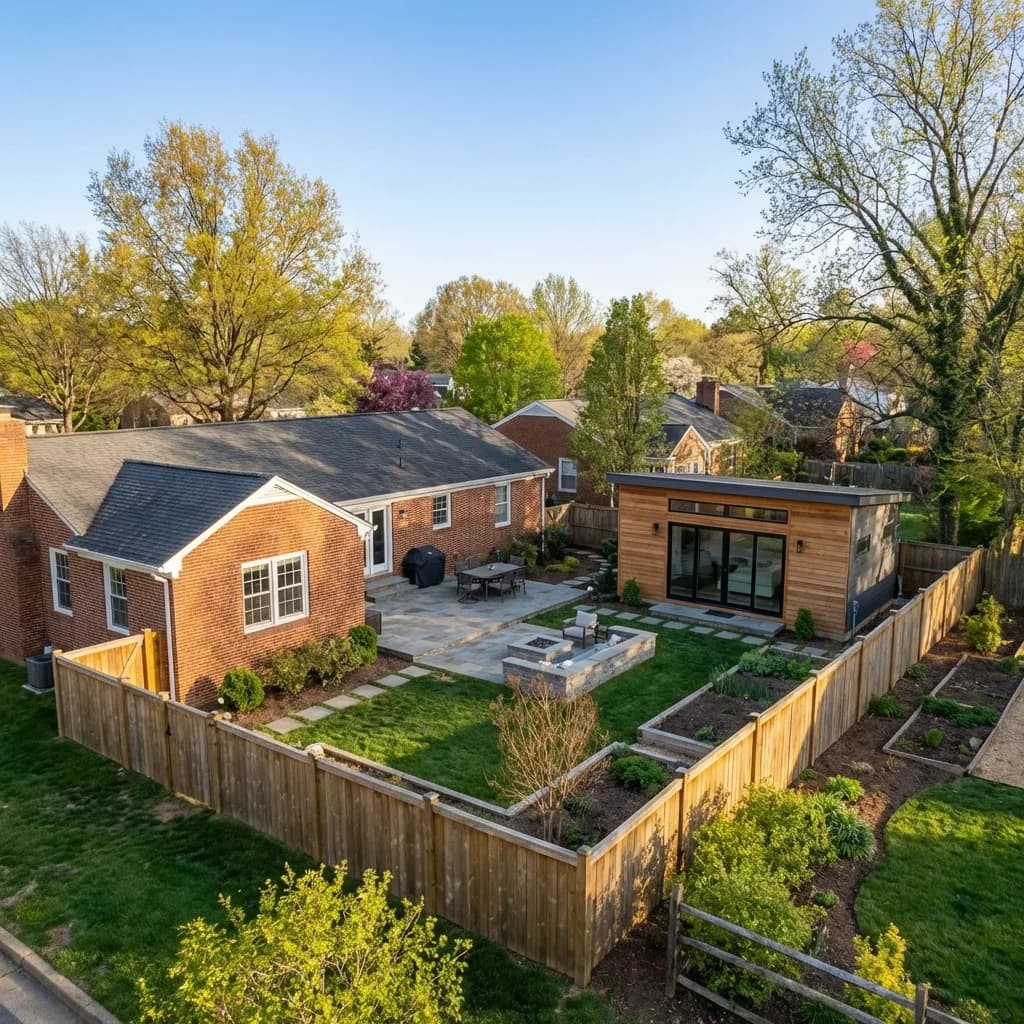
Fairfax County permits accessory living units on single-family residential lots. The unit can be attached to your existing home, built inside your home (like a basement conversion), or constructed as a detached structure in your yard.
Here are the key constraints every homeowner needs to understand before spending a dollar on design.
Size Limits
This is the single most misread rule, so read it carefully: the 800 square foot figure is the INTERIOR cap, not a blanket limit. An interior or attached ALU (built inside your home or sharing a wall) is capped at 800 square feet or 40% of the primary dwelling’s finished floor area, whichever is smaller, and is approved by administrative permit. So if your home is 1,800 square feet, an interior ALU cannot exceed 720 square feet (40% of 1,800).
A detached ALU, a separate structure in your yard, is different. It can be up to 1,200 square feet, but Fairfax County only allows a detached ALU on lots of at least 2 acres, and it requires a special permit with a public hearing before the Board of Zoning Appeals (BZA). On lots under 2 acres, a detached ALU is not currently permitted, so the interior or attached route is your path.
For most homes in Annandale, which sit well under 2 acres, that means an interior or attached unit, and the practical limit is 600–800 square feet. That’s enough for a comfortable one-bedroom or a tight two-bedroom, and it’s the sweet spot for rental income in this market.
Setback Requirements
Your ADU must comply with the same setback requirements as any accessory structure on your lot. In most residential zones in Fairfax County, that means:
- Front yard: The ADU cannot extend forward of the rear wall of the primary dwelling. In practice, this means the ADU goes in the back or side yard.
- Side yard: Typically 12 feet minimum from the side property line, though this varies by zoning district. In R-2 and R-3 zones, it may be as low as 8 feet.
- Rear yard:Typically 10–15 feet from the rear property line.
- Height: Detached ADUs are generally limited to 25 feet or the height of the primary dwelling, whichever is lower. Most single-story ADUs fall well within this limit.
These setback requirements are what make lot size and shape so critical. A wide, deep lot in Annandale gives you much more flexibility than a narrow lot in the City of Fairfax.
Lot Requirements
Lot size is where the interior versus detached distinction matters most. There is no minimum lot size for an interior or attached ALU, as long as it fits within the required setbacks, coverage limits, and parking requirements, it’s eligible. A detached ALU is different: Fairfax County only permits one on a lot of at least 2 acres (with a special permit before the Board of Zoning Appeals), so on a typical suburban lot the interior or attached route is the only option.
However, lot coverage limits apply. In most residential zones, impervious surface coverage (your house, driveway, ADU, patios, walkways) cannot exceed 25–30% of the total lot area. On a typical 10,000 square foot lot in Annandale, that gives you roughly 2,500–3,000 square feet of total impervious coverage to work with.
Parking Requirements
Fairfax County generally requires one additional off-street parking space for an ADU. This can be a driveway space, it does not have to be a garage. If your property already has a driveway with room for an additional car, this requirement is easily met.
Owner Occupancy
As of 2026, Fairfax County requires that the property owner reside in either the primary dwelling or the ADU. You cannot build an ADU and rent out both the main house and the unit while living elsewhere.
This is enforced through a covenant that runs with the property. If you sell the home, the new owner inherits the same requirement.
Short-Term Rental Restrictions
Fairfax County does not permit short-term lodging (stays under 30 days, the Airbnb-style nightly rental) in an ALU, so an ADU here is for long-term rental, meaning leases of 30 days or more. This is a rental income play, not a hospitality play.
Proposed changes: Fairfax is reviewing its ADU rules (2026)
One thing to keep on your radar: in 2026, Fairfax County staff proposed loosening several ALU rules. These are proposals under review, not adopted law, so everything above still applies today. The most significant proposals would drop the detached minimum lot size from 2 acres to 15,000 square feet (which the county estimates would raise eligible single-family detached homes from about 4.7% to 39%), raise the interior cap from 800 to 1,200 square feet, and remove the owner-occupancy and extra-parking requirements. Nothing changes until the Board of Supervisors adopts an amendment. You can follow it on the county’s Accessory Living Units amendment page.
The Permit Process: What to Expect
Getting a permit for an ADU in Fairfax County involves several departments and typically takes 30–90 days from submission to approval.
Step 1: Zoning Compliance Review
Before you submit building plans, you need a zoning determination confirming your property is eligible. This involves submitting a site plan showing the proposed ADU location, setbacks, and lot coverage calculations. The county reviews for compliance with zoning ordinance requirements.
Step 2: Building Permit Application
Once zoning is confirmed, you submit full construction documents, architectural plans, structural engineering, mechanical plans (HVAC, plumbing, electrical), and an energy compliance report. Everything goes through the PLUS portal, Fairfax County’s online permitting system.
Step 3: Chesapeake Bay Preservation Act Review
If your property is in a Resource Protection Area (RPA), additional environmental review is required. Many properties near streams and drainage ways in Fairfax County fall within these areas.
Step 4: Health Department Review
If your property is on septic (not connected to public sewer), the Health Department must confirm the septic system can support the additional occupants.
Step 5: Inspections During Construction
Once the permit is issued and construction begins, multiple inspections are required at key stages: foundation, framing, rough plumbing, rough electrical, insulation, and final inspection. Each must pass before the next phase proceeds.
Step 6: Certificate of Occupancy
After final inspection, the county issues a Certificate of Occupancy for the ADU. This is the document that confirms your unit is legally habitable and can be rented.
How Arlington and Alexandria Differ
If you’re across the county line in Arlington or the City of Alexandria, the rules are similar but not identical.
Arlington County has its own ADU ordinance with slightly different size limits and setback requirements. Arlington uses a zoning map that determines which residential districts allow ADUs by right versus requiring a use permit.
City of Alexandria requires compliance with its Design Standards for residential construction. ADUs must be architecturally compatible with the primary dwelling and the neighborhood character.
Each jurisdiction has its own permit review timeline and fee structure. The core principle is the same, you can build a legal ADU in Northern Virginia, but the specific rules depend on which side of the county line your property sits on.
How to Find Out If Your Property Qualifies
The fastest way to determine ADU eligibility for your specific property is a site-specific feasibility assessment that checks your lot dimensions, setbacks, coverage limits, zoning district, and utility connections.
Excell Homes has navigated the Fairfax County PLUS portal, Arlington permitting, and Alexandria DSP reviews on hundreds of residential projects over 20+ years. We handle the entire process, design, permits, and construction, under one fixed-price contract, and can point you to ADU financing based on your home’s after-renovation value.
This guide is for general informational purposes only and does not constitute legal, zoning, or professional advice. Accessory dwelling unit rules vary by property, zone, and lot size, and they are actively changing. Several jurisdictions in the DC metro are currently reviewing or revising their ADU regulations, including Fairfax County. The information here reflects our understanding at the time of writing and may become outdated. Nothing here is a guarantee that a given project is permittable. Always confirm current requirements for your specific property directly with the relevant authority (the DC Office of Zoning and Department of Buildings, the Montgomery County Department of Housing and Community Affairs and Department of Permitting Services, or Fairfax County Planning and Development) before making decisions or beginning a project. Excell Homes is not responsible for actions taken based on this information.