
Reface, Paint or Replace Kitchen Cabinets? A DC-Area Homeowner Guide
The short answer
If your cabinet boxes are solid and dry and you like where everything sits, painting or refacing can give you a new look and keep the structure you already have. If the boxes are water-damaged or failing, or you're changing the layout or appliance sizes, you need new cabinets. Refacing is the lower-cost path when the boxes are sound, according to our kitchen remodel cost guide. In homes built before 1978, any sanding or scraping of old paint brings federal lead-safe rules into play.
What's the difference between painting, refacing and replacing cabinets?
The three options get mixed up, so here is what each one usually means:
- Painting keeps your existing boxes, doors and drawer fronts. The surfaces are cleaned, prepped (often by sanding), primed and painted. Hardware is often swapped at the same time. The cabinets stay the same shape and size. Only the color and finish change.
- Refacing keeps the existing boxes, the structure that sits on the floor or hangs on the wall, and gives them new doors and drawer fronts, with a matching veneer over the visible frames.
- Replacing removes the old cabinets entirely and installs new boxes, doors and drawers. This is the only option that lets you change cabinet sizes, depths, heights or positions.
The key point: painting and refacing are both surface changes. Neither one fixes a box that is damaged, and neither one moves anything.
How do you know if your cabinet boxes are sound?
The cabinet box is the deciding factor in the reface vs replace kitchen cabinets question. Before you price new doors, open every cabinet and check:
- Under the sink. This is where water damage usually shows up first. Look for swelling, staining, soft spots, a sagging floor panel or peeling material. If the bottom of the sink base gives when you press on it, the box has a problem.
- Around the dishwasher and fridge. Slow leaks at these spots can damage the sides of nearby cabinets without being obvious from the front.
- Shelves and back panels. Sagging shelves, loose backs or separating joints mean the box is wearing out.
- Mounting. Wall cabinets should sit tight and level against the wall. Gaps or tilting point to fastening or framing problems.
- Smell and stains. A musty smell or dark staining inside a cabinet is a reason to find the moisture source before deciding anything.
If the boxes are solid, square and dry, painting or refacing are real options. If one or two boxes are damaged, ask whether they can be replaced individually to match. If the damage is widespread, or the source of the water hasn't been fixed, new doors on a failing box only cover up the problem.
When does a layout or appliance change force replacement?
This is the most common reason refacing or painting stops making sense, even when the boxes are in good shape. Painting and refacing keep every cabinet exactly where it is, at the size it is. Plan on new cabinets if any of the following is part of your plan:
- Moving the sink, range or dishwasher. The cabinets around those fixtures are sized and cut for them. Moving them means new bases in new places.
- Adding an island or a peninsula, or removing one.
- Opening a wall between the kitchen and the dining or living area.
- Changing appliance sizes. A wider range, a counter-depth or larger fridge, a panel-ready dishwasher or a new wall oven usually needs a different cabinet opening. Our cost guide puts it simply: choose and order appliances early, because "the cabinetry is sized around them."
- Changing cabinet height or depth, for example taking wall cabinets to the ceiling.
Layout changes are also where budgets grow. Our cost guide recommends keeping the existing layout where possible, because moving plumbing and walls is where budgets climb. If you're on the fence, decide on the layout first. The cabinet decision usually follows from it.
Is it cheaper to reface or replace cabinets?
When the boxes are sound, refacing is generally the cheaper path. Our kitchen remodel cost guide notes that refacing is the lower-cost path when the cabinet boxes are sound.
Cabinets matter a lot to the budget because of how much of a kitchen remodel they represent. In Excell Homes' planning ranges, cabinets are typically 25% to 30% of a kitchen budget, usually the largest single line item (see the budget breakdown in our cost guide). The rest goes to labor, countertops, appliances, flooring, lighting, other finishes and permits.
A few things to weigh beyond the cabinet line itself:
- Countertops. Refacing and painting usually keep the existing countertops in place. If you also want new countertops, ask how the work will be sequenced.
- Everything else stays the same. If you're also replacing flooring, lighting and appliances, the cabinets become one part of a larger project. At that point, compare the full scope rather than cabinets alone.
- Ask for itemized quotes. Our cost guide recommends detailed, itemized quotes, not lump-sum numbers. That makes it much easier to compare a paint, reface and replace quote side by side.
For full-remodel planning ranges by kitchen size and finish level, see How Much Does a Kitchen Remodel Cost in the DC Metro?
Do you need a permit to reface, paint or replace kitchen cabinets?
Usually not, as long as nothing else changes. Our kitchen and bath permit guide summarizes what each local office publishes. Finish work such as cabinets, countertops, flooring and paint generally needs no permit in Montgomery County, Rockville, Fairfax County, or DC outside its historic districts. The exceptions are worth knowing:
- Gaithersburg requires a Residential Improvement Permit for work such as remodeling kitchens and bathrooms, so check with the City before starting even a same-layout update.
- DC historic districts. DC's list of permit-free work applies only outside historic districts, so confirm with DC's Department of Buildings first.
- Moving things changes the answer. Moving a sink, range or dishwasher means moving plumbing, gas lines or wiring. That was permit work in every jurisdiction the guide checked.
- Appliances can trigger permits on their own. For example, Fairfax County lists direct replacement of household appliances such as stoves and ovens as permit work. In Montgomery County, installing or replacing a range hood requires a mechanical permit from the county's Department of Permitting Services (DPS).
So a paint or reface project on its own is usually permit-free. A replacement that comes with a new layout or new appliances usually isn't. For jurisdiction-by-jurisdiction detail, see Do You Need a Permit to Remodel a Kitchen or Bathroom?
What if your home was built before 1978?
This matters for painting in particular, and for refacing too. Painting cabinets usually starts with sanding, and refacing can involve scraping, sanding or cutting old finished surfaces. In older homes, those surfaces may include lead-based paint, even under newer coats.
As of November 2026, the U.S. EPA's Renovation, Repair and Painting (RRP) Rule page explains the concern: "These activities can create hazardous lead dust when surfaces with lead paint, even from many decades ago, are disturbed."
The same page says that under the rule, "firms performing renovation, repair and painting projects that disturb lead-based paint in homes, child care facilities, and kindergartens built before 1978 must be EPA- or state-certified and must use certified renovators who follow specific work practices to prevent lead contamination."
What that means in practice:
- Know your home's build year. 1978 is the cutoff for EPA's lead-safe renovation rules.
- If you hire a firm to paint, sand or reface cabinets in a pre-1978 home, ask whether the firm is EPA- or state-certified and whether a certified renovator will be on the job.
- Don't assume cabinets are lead-free because they look newer. They may have been painted over, or may sit next to original painted trim and walls that the work will disturb.
EPA has separate guidance for do-it-yourselfers on its lead pages. If you plan to sand or strip cabinets yourself, read it before you start.
Reface vs replace kitchen cabinets: a decision checklist
Go through these questions in order.
- Are the boxes dry, solid and square? Check under the sink, around the dishwasher, shelves, backs and mounting. No: replace the damaged boxes, and fix the water source first.
- Are you keeping the layout? Same sink, range and dishwasher locations, with no island added or removed and no wall coming down. No: plan on replacement.
- Are your appliances staying the same size? No: the cabinets around them likely need to change.
- Does the current storage work for you? Painting and refacing keep the same interior space. If you want more drawers, deeper bases or taller uppers, consider replacing.
- Was the home built before 1978? Yes: any sanding, scraping or cutting of painted surfaces should follow EPA's lead-safe rules. Ask any firm about certification.
- Is anything else in the kitchen changing? If you're also redoing countertops, flooring, lighting and appliances, compare the full project, not cabinets alone. See our cost guide.
- Does the work need a permit where you live? Cabinets alone usually don't, but Gaithersburg, DC historic districts and any plumbing, gas, electrical or appliance changes are exceptions. Check our permit guide.
- Have you vetted the contractor? In Maryland, the state's Home Improvement Commission advises: "Ask to see every contractor's MHIC license and then check with MHIC to make sure the license is still current." It also advises: "If your project requires a building permit from your local jurisdiction, confirm that your contractor will obtain all necessary permits."
If you answered yes to the first four, painting or refacing is worth pricing. If you hit a "no" early, especially on layout or water damage, new cabinets are probably the right call. In that case it usually makes sense to plan the whole kitchen at once.
Where Excell fits
Excell Homes is a design-build remodeler that does full kitchen remodels.
If your checklist pointed to a full remodel, we design the space, handle the permits and build the kitchen under one contract. Excell Homes has 20+ years and 2,500+ projects behind it, and we've built full kitchen remodels in Montgomery County, Washington DC and Northern Virginia. Excell Homes is licensed in Virginia, Maryland and DC. To talk through your kitchen, request a free estimate or call (301) 832-0409.
Frequently asked questions
Should I reface or replace kitchen cabinets?
Reface if the cabinet boxes are solid and dry and you're keeping the same layout and appliance sizes. Replace if the boxes are water-damaged or failing, or if you're moving the sink, range or dishwasher, adding or removing an island, or changing appliance sizes. Painting and refacing only change surfaces, so they can't fix a damaged box or move anything.
Is it cheaper to reface or replace cabinets?
When the boxes are sound, refacing is generally the lower-cost path, according to Excell Homes' kitchen remodel cost guide. Cabinets are typically 25% to 30% of a kitchen remodel budget in Excell Homes' planning ranges, which makes them usually the largest single line item. Itemized quotes make it easier to compare options side by side.
What is the difference between painting and refacing cabinets?
Painting keeps your existing boxes, doors and drawer fronts and changes only their color and finish. Refacing keeps the boxes and gives them new doors and drawer fronts, with a matching veneer over the visible frames. Both keep the cabinets in the same positions and sizes.
When do kitchen cabinets need to be replaced instead of refaced?
When the boxes have water damage, swelling, soft spots or failing joints, or when the layout or appliance sizes are changing. Moving a sink or range, adding an island, opening a wall, or fitting a different-size fridge or range usually requires new cabinets in new positions or sizes.
Do I need a permit to replace or reface kitchen cabinets in the DC area?
Usually not. Cabinets are generally listed as permit-free finish work in Montgomery County, Rockville, Fairfax County, and DC outside its historic districts. Gaithersburg requires a Residential Improvement Permit for work such as remodeling kitchens, and moving plumbing, gas or wiring needed a permit in every jurisdiction Excell Homes checked.
Is it safe to sand and paint cabinets in an older home?
In homes built before 1978, sanding or scraping can disturb lead-based paint. EPA says firms doing renovation, repair and painting that disturbs lead-based paint in pre-1978 homes must be EPA- or state-certified and use certified renovators who follow specific work practices. Ask any firm about its certification before work starts, and read EPA's do-it-yourself guidance if you plan to do it yourself.
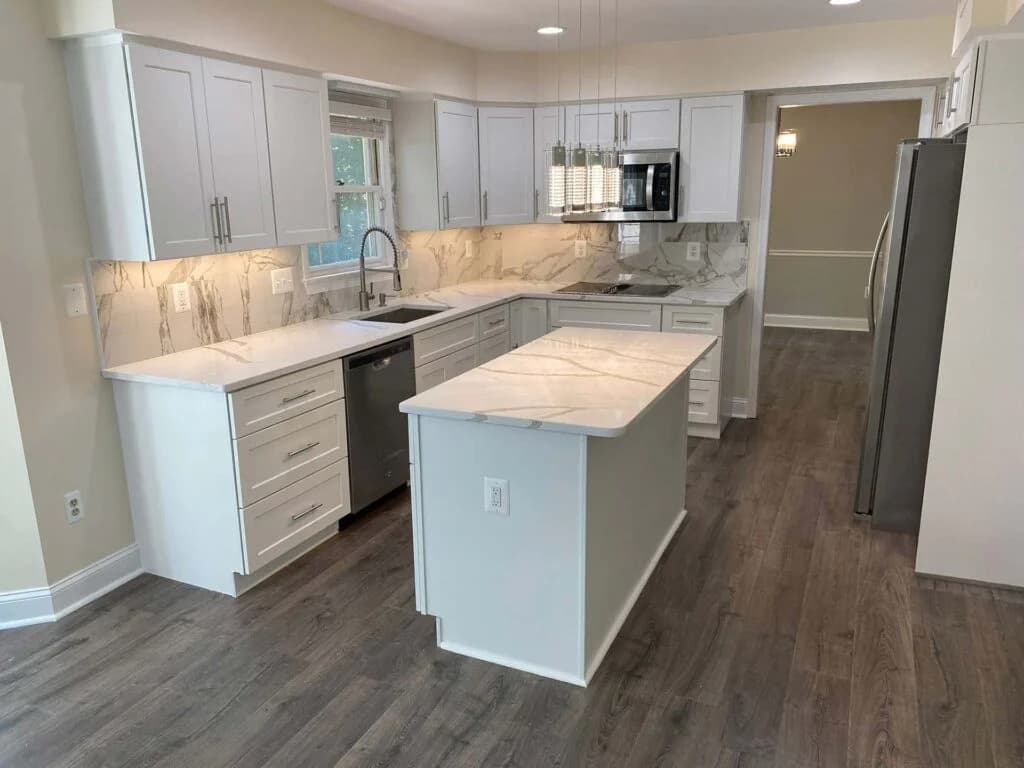
Recent full kitchen remodels from our team across Montgomery County, Washington DC and Northern Virginia. Kitchen Remodel in Rockville, MD, Kitchen Remodel with a Lit Island in Bethesda, MD, White Kitchen Remodel in Washington, DC, and Kitchen Remodel in Fairfax, VA.
Related guides
- How much a kitchen remodel costs in the DC metro
- Do you need a permit to remodel a kitchen or bathroom? (DC, MD & VA)
- Kitchen remodeling in Montgomery County: a local guide
Where we build
Excell Homes remodels homes across the DC metro. Explore our work by area:
This guide summarizes what each permitting office and the U.S. EPA publish, as of November 2026. It is not legal advice. Offices interpret their own rules, the rules change, and a town or city can add requirements of its own, so confirm with the office that governs your address before you start work. Excell Homes is not responsible for actions taken based on this information.