
How Much Does an ADU Cost in Northern Virginia? A Realistic 2026 Breakdown
Regulations last verified: September 2026
The short answer
Nationally, the average ADU costs about $180,000 to build, with most projects falling between $40,000 and $360,000 (as reported by AARP, 2026). In Northern Virginia, a turnkey detached ADU typically runs $150,000 to $250,000 as of 2026, above the national average.
Conversions are the cheaper way in: a garage conversion runs $80,000 to $150,000 and a basement conversion $60,000 to $120,000, because the shell already exists. Northern Virginia sits above the national number for three reasons, covered in detail below: higher trade labor rates, a permitting process that adds professional fees before construction starts, and high land values that produce tight lots and more site work.
If you own a single-family home in Fairfax County, Arlington, or Alexandria and you’ve been researching accessory dwelling units, the first question on your mind is almost certainly: what’s this going to cost me?
The short answer: most homeowners in Northern Virginia spend between $150,000 and $250,000 for a turnkey detached ADU. But that range is wide for a reason. The final number depends on the type of ADU, the size, the site conditions on your specific lot, and the level of finish you’re targeting.
This guide breaks down every cost component so you can plan with real numbers, not guesswork.
What is the average cost to build an ADU, and how does Northern Virginia compare?
The national average to build an ADU is about $180,000, with most projects landing between $40,000 and $360,000, as reported by AARP in its accessory dwelling unit guidance, 2026. In Northern Virginia, a turnkey detached ADU typically costs $150,000 to $250,000 as of 2026, putting the local midpoint above the national average.
A national average blends markets that are not really comparable, which is why it is a poor planning number for a specific lot in Fairfax County or Arlington. It averages in regions where labor, land, and permitting all cost substantially less than they do inside the Washington DC metro.
| Cost basis | National (2026) | Northern Virginia (2026) |
|---|---|---|
| Average cost to build an ADU | About $180,000, across all ADU types | $150,000 to $250,000 for a turnkey detached unit |
| Typical overall range | $40,000 to $360,000 | $60,000 to $250,000 across conversions and new builds |
| What sets the number | A blend of all US markets, including low-cost regions | DC-metro trade labor, local permitting, and high land values |
Source for the national figures: AARP, accessory dwelling unit guidance, 2026 (plain-text attribution, deliberately not linked). Three specific forces push the Northern Virginia number above it.
Labor
Skilled trade labor is the largest single driver of the gap, running roughly 15 to 25 percent above national rates across the DC metro. The region competes for the same framers, electricians, plumbers, and HVAC technicians as federal, commercial, and high-end residential work, which holds wages up regardless of what national cost calculators assume.
Permitting and professional services
Northern Virginia jurisdictions require more review before construction than a typical US market, and that review has to be paid for in drawings and professional fees. In Fairfax County an Accessory Living Unit needs an administrative permit at $285 application, $75 renewal, which the county states takes approximately 30 calendar days to process, and Arlington and Alexandria each run their own separate processes.
The permit fee itself is minor. The real cost is the package required to obtain it: architectural plans, structural engineering, surveys, and any environmental or health review, which together typically run $8,000 to $15,000 before a shovel hits dirt.
Land and lot constraints
High land values in Northern Virginia mean smaller lots, tighter setbacks, and more complicated site work than in markets where the national average was set. Fairfax County also permits a detached ALU only on lots of at least two acres, and only with a special permit, so most homeowners on a standard suburban lot are building an interior or attached unit, or taking on a more constrained site.
Constrained sites cost more to build on. Trenching utilities from the house to a detached unit, grading around mature trees, and meeting stormwater requirements commonly add $10,000 to $25,000 that a national per-square-foot figure never accounts for.
Find out if your lot qualifies →
What Drives ADU Costs in Northern Virginia?
Northern Virginia is not a typical construction market. Labor rates here are 15–25% higher than the national average. Fairfax County’s permitting process (they call them “Accessory Living Units”) adds weeks of review time. Arlington has its own zoning overlay. Alexandria requires Design Standards compliance.
All of that translates into cost, not just in materials and labor, but in the professional services required to navigate the system before a single shovel hits dirt.
Here are the primary cost drivers that determine where your project lands.
Cost Breakdown by ADU Type
Detached ADU (New Construction)
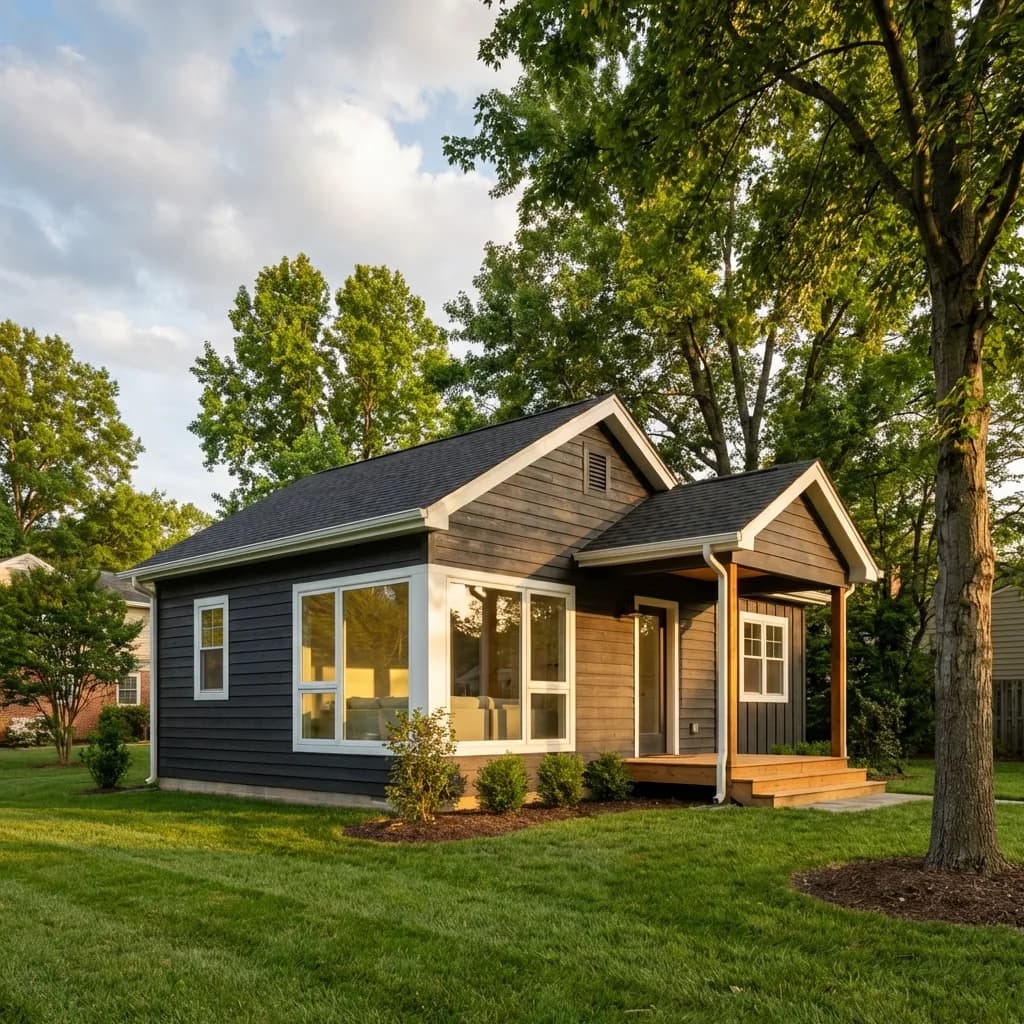
A detached ADU is a standalone structure in your backyard, its own foundation, walls, roof, and utility connections. Detached units are popular where the lot allows, but note that in Fairfax County a detached ALU specifically requires a lot of at least two acres and a special permit, so on the many smaller lots an interior or attached unit is the path.
Typical cost: $150,000 – $250,000 for a 400–800 sq ft unit.
This includes architectural design, engineering, all permits, site preparation, foundation, framing, roofing, plumbing, electrical, HVAC, insulation, drywall, flooring, kitchen, bathroom, and finish work.
What it does not include: landscaping restoration, fencing, or furniture.
Attached ADU (Addition to Existing Home)
An attached ADU shares at least one wall with your primary residence. This can be less expensive because you may not need a separate foundation for the full footprint, but the structural tie-in to your existing home adds complexity.
Typical cost: $120,000 – $200,000 for a 400–600 sq ft unit.
The savings come from shared walls and potentially shared utility connections. The added cost comes from structural engineering to ensure the addition integrates safely with your existing home’s load path.
Garage Conversion ADU
Converting an existing detached or attached garage into a living unit is typically the least expensive option because the shell already exists. However, most garages in Northern Virginia were not built to residential building code standards, which means you’ll likely need foundation upgrades, insulation, HVAC, plumbing, and electrical work.
Typical cost: $80,000 – $150,000 depending on the condition of the existing structure.
The catch: if your garage doesn’t have adequate ceiling height (at least seven feet in most NoVA jurisdictions), the conversion may not be feasible without significant structural work.
Interior ADU (Basement Conversion)
If your home has an unfinished or partially finished basement with separate egress (or the ability to add it), an interior ADU can be the fastest path to rental income.
Typical cost: $60,000 – $120,000 for a 500–800 sq ft unit.
The primary requirements are a separate entrance, a full kitchen, a bathroom, and compliance with egress window requirements for bedrooms. Many homes in Annandale, Fairfax, and Falls Church have walkout basements that are ideal candidates.
The Hidden Costs Most Quotes Don’t Include
Permitting and Professional Fees
In Fairfax County, the permitting process for an ADU involves multiple departments: zoning review, building permits, health department approval (if on septic), and potentially a Chesapeake Bay Preservation Act review.
Budget $8,000 – $15,000 for architectural plans, structural engineering, permit fees, and any required surveys or environmental reports. This is before construction begins.
Site Work and Utilities
Running water, sewer, and electrical service to a detached ADU requires trenching from your main house to the new structure. If your lot has significant grade changes (common in Annandale and Falls Church), site preparation costs increase.
Budget $10,000 – $25,000 for utility connections, site grading, and any required stormwater management.
Impact Fees
Some NoVA jurisdictions charge impact or connection fees for new dwelling units. These vary by locality and can range from $2,000 to $8,000.
Cost Per Square Foot in Northern Virginia
As a rough planning tool, here’s what NoVA homeowners typically pay per square foot for ADU construction in 2026:
- Economy finish (builder-grade materials, basic kitchen, standard fixtures): $200 – $275 per sq ft
- Mid-range finish (upgraded cabinets, quartz countertops, LVP flooring, decent fixtures): $275 – $375 per sq ft
- High-end finish (custom cabinets, high-end appliances, hardwood floors, designer fixtures): $375 – $500+ per sq ft
Most homeowners building for rental income target the mid-range finish level. It attracts quality tenants, commands strong rents, and doesn’t overcapitalize the unit.
The ROI That Makes the Cost Worth It
Here’s why homeowners build ADUs despite the six-figure price tag.
Annandale’s overall median rent, across all apartment sizes, was $2,184/month in the Apartment List, Annandale rent report, October 2026, with rents down 5.0% year over year. The report does not break rent down by bedroom count.
At that median rent, a $200,000 ADU generates $26,208 per year in gross rental income. Even after property management, maintenance, and vacancy (budget 20% for all three), you’re netting roughly $21,000 per year.
On those figures, simple payback is about ten years ($200,000 divided by roughly $21,000 a year), in line with the breakdown in our Northern Virginia ADU rental income guide. That is before accounting for any increase in property value a permitted, finished ADU adds.
You’re building equity and generating income simultaneously.
Concerned about the upfront cost? You don’t have to pay out of pocket. Through our RenoFi partnership you can finance the build against your home’s after-renovation value, so the new unit can help pay for itself.
How to Get an Accurate Estimate for Your Property
Every lot in Northern Virginia is different. Setback requirements, utility locations, soil conditions, tree preservation ordinances, and HOA restrictions (if applicable) all affect cost. The only way to get a real number is a site-specific feasibility assessment.
Excell Homes is a turnkey ADU builder serving Fairfax County, Arlington, Alexandria, Annandale, Falls Church, McLean, Springfield, and Vienna. We handle design, permitting, and construction under one fixed-price contract.
Frequently asked questions
How much does an ADU cost in Northern Virginia?
A turnkey detached ADU in Northern Virginia typically costs $150,000 to $250,000 as of 2026. Attached units run $120,000 to $200,000, garage conversions $80,000 to $150,000, and basement conversions $60,000 to $120,000. Where you land depends on size, site conditions, and finish level.
What is the average cost to build an ADU nationally?
Nationally the average ADU costs about $180,000, with most projects falling between $40,000 and $360,000, as reported by AARP in its 2026 accessory dwelling unit guidance. Northern Virginia sits above that average, because regional labor rates, permitting requirements, and land constraints all push the local number higher.
Why do ADUs cost more in Northern Virginia than the national average?
Three reasons. Skilled trade labor in the DC metro runs well above national rates, Fairfax County and neighboring jurisdictions require review that adds professional fees before construction starts, and high land values mean smaller lots with tighter setbacks and more complex site work.
What is the cheapest type of ADU to build?
A basement or interior conversion is cheapest, typically $60,000 to $120,000 in Northern Virginia, because the foundation, walls, and roof already exist. A garage conversion is next at $80,000 to $150,000. A new detached unit costs the most, because everything is built from scratch.
What costs do ADU quotes usually leave out?
Permitting and professional fees of roughly $8,000 to $15,000, utility connections and site work of $10,000 to $25,000, and impact or connection fees of $2,000 to $8,000 in some jurisdictions. Landscaping restoration after trenching, fencing, window treatments, and furniture are also typically excluded from a build quote.
How long does it take to recoup the cost of an ADU?
At $2,184 a month (Annandale's overall median rent for all apartment sizes), a $200,000 ADU grosses about $26,200 a year, netting near $21,000 after management, maintenance, and vacancy. On those figures simple payback is about ten years, before any property-value increase a permitted unit adds.
We build across Northern Virginia; recent local work includes New Home in Annandale, VA, Whole-Home Renovation in Virginia, and Kitchen Remodel in Leesburg, VA.
Related guides
- Garage & basement ADU conversion cost in Northern Virginia
- How long does it take to build an ADU in Northern Virginia?
- How to finance an ADU: HELOC, refinance & construction loans
- Detached vs. attached ADU: which is right for your lot?
- How much rental income can an ADU earn in Northern Virginia?
- ADU rules in DC, Maryland & Virginia
Where we build
Excell Homes designs, permits, and builds ADUs across the DC metro. Explore our work by area:
This guide is for general informational purposes only and does not constitute legal, zoning, or professional advice. Accessory dwelling unit rules vary by property, zone, and lot size, and they are actively changing. Several jurisdictions in the DC metro are currently reviewing or revising their ADU regulations, including Fairfax County. The information here reflects our understanding at the time of writing and may become outdated. Nothing here is a guarantee that a given project is permittable. Always confirm current requirements for your specific property directly with the relevant authority (the DC Office of Zoning and Department of Buildings, the Montgomery County Department of Housing and Community Affairs and Department of Permitting Services, or Fairfax County Planning and Development) before making decisions or beginning a project. Excell Homes is not responsible for actions taken based on this information.