
Detached vs Attached ADU: Which Is Right for Your Northern Virginia Property?
Regulations last verified: September 2026
You’ve decided to build an ADU. You know the rental income potential. You’ve checked the zoning. Now comes the decision that determines your construction cost, your tenant experience, and your long-term property value: do you build detached or attached?
The answer depends on your lot, your budget, and what you want the ADU to do for you. Here’s an honest comparison of both options based on what we see building ADUs across Fairfax County, Arlington, and Alexandria.
The short version
- Detached ADUs cost more (about $150K–$250K) but earn higher rent, offer complete privacy, and add the most resale value.
- Attached ADUs run roughly 15–25% less (about $120K–$200K) and are often the only option that fits a smaller Northern Virginia lot.
- In Fairfax County, a detached ADU (ALU) is only allowed on lots of at least two acres with a special permit, so most lots take the attached or interior route.
- For an in-law suite, attached wins on proximity; for rental income, detached wins on the privacy premium and lower vacancy.
- Your lot usually makes the decision, not preference. A site-specific assessment is the fastest way to know which is even feasible.
Detached vs. attached ADU at a glance
| Detached ADU | Attached ADU | |
|---|---|---|
| Typical cost (same size) | $150K–$250K | $120K–$200K (~15–25% less) |
| Privacy | Complete separation, own walls & entrance | Shares at least one wall with the main home |
| Rental appeal | Higher rent, longer tenancies | Lower; some renters avoid shared-wall units |
| Construction disruption | None inside your home, work stays in the yard | Cutting into the existing home, noise & dust |
| Timeline (permit to done) | 12–16 weeks | 10–14 weeks (more delay-prone) |
| Resale value add | ~$125K–$175K | ~$80K–$130K |
| Best for | Rental income, maximum privacy, resale | In-law suites, tight lots, a firm budget |
What’s the Difference?
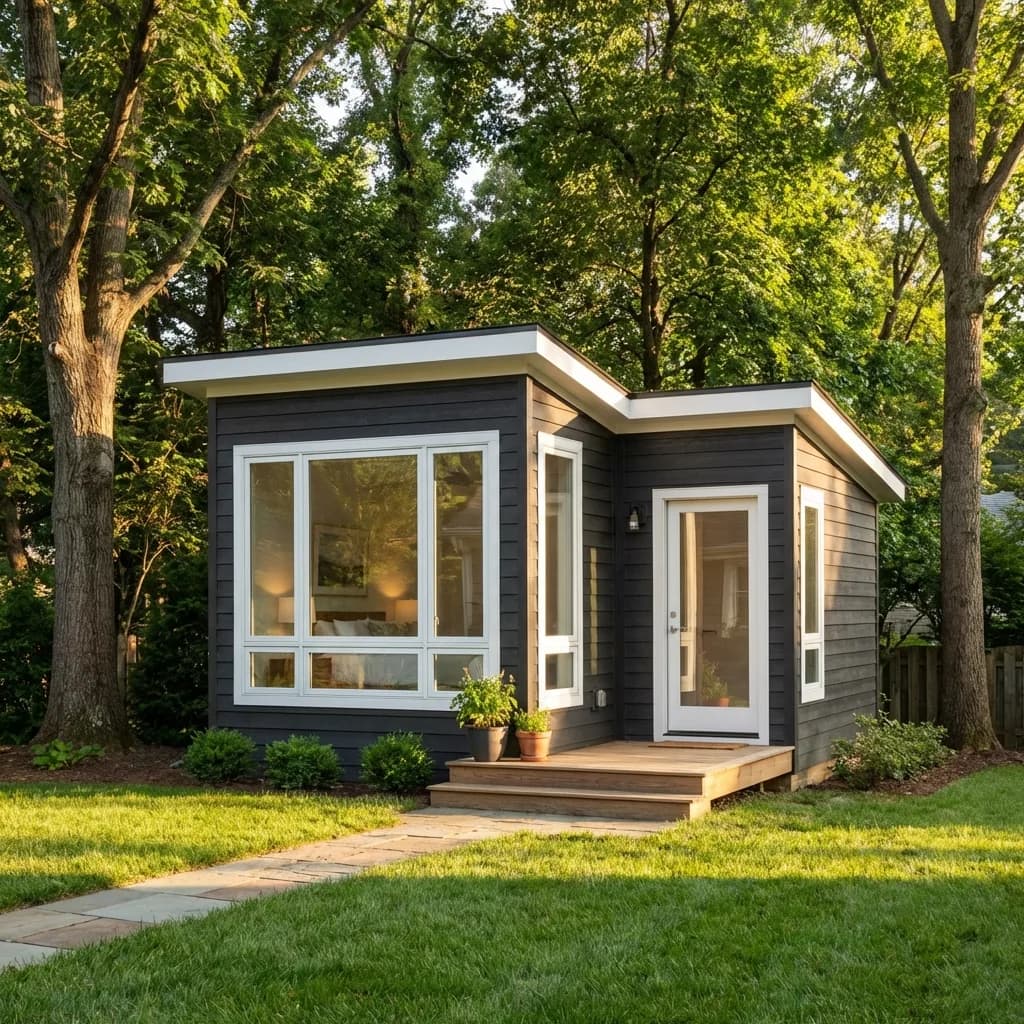
A detached ADU is a completely separate structure built in your backyard or side yard. It has its own foundation, walls, roof, entrance, and utility connections. It shares nothing structurally with your primary home. Think of it as a small house behind your big house.
An attached ADU shares at least one wall with your primary residence. It’s an addition to your existing home that functions as a self-contained living unit with its own kitchen, bathroom, entrance, and living space. From the outside, it looks like a home addition. From the inside, it’s a separate apartment.
Both types are legal in Fairfax County, Arlington, and Alexandria (subject to zoning district rules). Both can be rented for income. Both add value to your property. But they differ in cost, construction complexity, privacy, and tenant appeal.
Cost Comparison
Detached ADU
Typical range: $150,000 – $250,000 for a 400–800 sq ft unit.
The detached ADU costs more because you’re building a complete structure from scratch: foundation, full framing, four exterior walls, a standalone roof, and independent utility connections. Running water, sewer, and electrical service from your main house to a separate structure requires trenching and connection work.
The upside: no structural impact on your existing home. No need to modify your home’s foundation, roof line, or load-bearing walls.
Attached ADU
Typical range: $120,000 – $200,000 for a 400–600 sq ft unit.
An attached ADU is generally 15–25% less expensive than a detached unit of the same size. You save on foundation work (the addition ties into your existing foundation or extends it on one side), shared wall construction (one wall already exists), and utility connections (shorter runs from your existing plumbing, electrical, and HVAC systems).
The catch: attaching a new structure to an existing home requires structural engineering to ensure the addition integrates safely. If your home’s foundation needs reinforcement or your roof line needs modification, those costs can eat into the savings.
Privacy and Tenant Appeal
This is where detached ADUs win decisively, and it directly affects how much rent you can charge.
Detached: Maximum Privacy
A detached ADU provides complete physical separation between you and your tenant. Separate entrance, separate walls, no shared noise transmission, no shared vibrations. Your tenant feels like they’re renting a small house, not a room in someone’s home.
This privacy premium translates to higher rents. In the Annandale market, a well-finished detached ADU commands $100–$200/month more than a comparable attached unit. Over a year, that’s $1,200–$2,400 in additional income.
Tenants also tend to stay longer in detached units. Lower turnover means lower vacancy costs and fewer tenant acquisition expenses.
Attached: Shared Walls, Shared Concerns
An attached ADU shares at least one wall with your primary home. Even with proper soundproofing (insulation, resilient channel, double drywall), some noise transmission is inevitable. Your tenant hears your dog bark. You hear their music.
For in-law suites where the occupant is a family member, this proximity is often a feature, not a bug. Your aging parent is steps away, literally through a connecting door if you choose to include one.
For market-rate rental tenants, the shared wall is a drawback. Some tenants specifically search for detached units to avoid the dynamics of living physically connected to their landlord.
Construction Complexity
Detached: Simpler Construction, Longer Timeline
Paradoxically, a detached ADU is simpler to build even though it costs more. You’re working on a clean site with no existing structure to integrate with. Your construction crew works independently of your home. No need to cut into existing walls, reroute existing utilities, or protect existing finishes during construction.
You can also continue living normally in your home during construction. The work happens in the backyard. The noise and dust stay outside.
Timeline: 12–16 weeks from permit to completion.
Attached: Complex Integration, Shorter Potential Timeline
An attached ADU requires cutting into your existing home. That means opening exterior walls, potentially modifying the roof line, extending the foundation, and connecting new plumbing, electrical, and HVAC systems to existing ones.
This integration work is where surprises live. Open a 30-year-old wall in Annandale and you might find outdated wiring, inadequate insulation, or structural issues that need addressing before the addition can proceed.
The construction also happens adjacent to your living space. Expect noise, dust, and temporary disruptions to your daily routine.
Timeline: 10–14 weeks from permit to completion (slightly faster due to shared wall, but more vulnerable to delays from existing-home complications).
Resale Value Impact
Both ADU types increase your property’s value, but the market values them differently.
Detached: Strongest Value Add
A detached ADU is valued by appraisers as a distinct income-producing asset. Using the income capitalization approach, appraisers assign value based on the ADU’s demonstrated rental income. A detached ADU renting at Annandale’s overall median of $2,184/month (all apartment sizes) adds approximately $125,000–$175,000 in appraised value.
From a buyer’s perspective, a detached ADU offers flexibility. The new owner can rent it, use it as a guest house, convert it to a home office, or house family members. The separate structure doesn’t constrain the use of the primary home.
Attached: Moderate Value Add
An attached ADU adds value, but appraisers sometimes classify it more like a home addition than a separate income-producing unit. The value add is typically $80,000–$130,000.
Some buyers view an attached ADU as a bonus. Others see it as an awkward layout modification. The perception depends heavily on how well the addition integrates architecturally with the original home.
Which Should You Choose?
The decision framework is straightforward.
Build Detached If:
- Your lot has the space. You have adequate setbacks and lot coverage budget for a standalone structure. Note that in Fairfax County a detached ALU is only permitted on lots of at least two acres (with a special permit), so on smaller lots the attached or interior route is the option.
- You want maximum rental income. The privacy premium and tenant appeal of a detached unit generate higher rents and lower vacancy.
- You want to avoid construction disruption. Your home stays untouched during the build.
- You want the strongest resale value impact. Detached ADUs are valued more consistently by appraisers and buyers.
Build Attached If:
- Your lot is too small or too narrow for a detached structure. Some properties in Arlington and Alexandria don’t have the setback clearance for a standalone building.
- The ADU is for family, not tenants. If you’re building an in-law suite for aging parents, the proximity of an attached unit is an advantage. You can include a connecting interior door for easy access while maintaining a separate entrance for independence.
- Your budget is firm below $150K. An attached ADU gives you a self-contained living unit at a lower cost than detached construction.
Not Sure Which Option Fits Your Property?
Your lot dimensions, setbacks, utility locations, and zoning district determine which ADU type is feasible, and in some cases, only one option works. The fastest way to find out is a site-specific assessment.
Excell Homes builds both detached and attached ADUs across Fairfax County, Arlington, Alexandria, Annandale, Falls Church, McLean, Springfield, and Vienna. Design, permits, and construction, one team, one contract, one fixed price.
Frequently asked questions
Is a detached or attached ADU cheaper?
Attached is generally 15 to 25 percent less than a detached unit of the same size, because it reuses an existing wall, ties into the existing foundation, and needs shorter utility runs. The caveat: opening up an older home can surface wiring, insulation, or structural issues that eat into those savings.
Which ADU type rents for more?
A detached ADU. The complete privacy of a standalone unit commands a premium, roughly $100 to $200 more per month in the Annandale market, and tenants tend to stay longer, which lowers vacancy and turnover costs over time.
Can I build a detached ADU on a small lot in Fairfax County?
Usually not. Fairfax County allows a detached Accessory Living Unit only on lots of at least two acres, and it requires a special permit. On smaller lots, an interior or attached ALU, capped at 800 square feet or 40% of the principal dwelling's gross floor area, whichever is less, is the route that works.
Which type adds more resale value?
Detached, in most cases. Appraisers often value a detached ADU as a separate income-producing asset, adding roughly $125,000 to $175,000 in the Annandale market, while an attached unit is sometimes treated more like an addition, adding about $80,000 to $130,000.
Is an attached ADU better for an in-law suite?
Often, yes. For family, the proximity is a feature: you can add a connecting interior door for easy access while keeping a separate entrance for independence. For market-rate tenants, though, the shared wall is usually a drawback rather than a selling point.
How long does each type take to build?
A detached ADU typically takes 12 to 16 weeks from permit to completion. An attached ADU runs about 10 to 14 weeks thanks to the shared wall, but it is more vulnerable to delays when integration work uncovers issues in the existing home.
Recent Northern Virginia projects: Whole-Home Renovation in Virginia, and New Home in Annandale, VA.
Related guides
- How much does an ADU cost in Northern Virginia?
- Garage & basement ADU conversion cost in Northern Virginia
- How long does it take to build an ADU in Northern Virginia?
- Fairfax County ADU zoning guide
- ADU rental income in Northern Virginia
- Our turnkey ADU design, permits & build
Where we build
Excell Homes designs, permits, and builds ADUs across the DC metro. Explore our work by area:
This guide is for general informational purposes only and does not constitute legal, zoning, or professional advice. Accessory dwelling unit rules vary by property, zone, and lot size, and they are actively changing. Several jurisdictions in the DC metro are currently reviewing or revising their ADU regulations, including Fairfax County. The information here reflects our understanding at the time of writing and may become outdated. Nothing here is a guarantee that a given project is permittable. Always confirm current requirements for your specific property directly with the relevant authority (the DC Office of Zoning and Department of Buildings, the Montgomery County Department of Housing and Community Affairs and Department of Permitting Services, or Fairfax County Planning and Development) before making decisions or beginning a project. Excell Homes is not responsible for actions taken based on this information.