
What Not to Do in a Kitchen Remodel: Mistakes DC-Area Homeowners Can Avoid
The short answer
In the DC area, the biggest kitchen remodel mistakes usually come from doing things in the wrong order or skipping paperwork, not from bad taste. Common ones are starting without the right permit, hiring a contractor who isn't licensed, disturbing old paint without lead-safe practices, and picking cabinets before the layout and appliances are settled. Set the layout first, then choose appliances, then cabinets and finishes. Put every selection in a signed written contract, and budget for any work that moves plumbing, gas, wiring or walls.
What is the most common mistake in a kitchen remodel?
Most problems trace back to one thing: making decisions in the wrong order. A homeowner falls in love with a cabinet door and orders it. Then they find out the range they want is a different width, the sink can't move without a permit, or the wall they wanted gone is load-bearing. Each of those surprises costs money because something already bought or built has to change.
The mistakes below come up again and again in DC-area kitchens. Most are cheap to avoid if you catch them before demolition and expensive to fix afterward.
Mistake 1: Should you skip the permit to save time?
No. Skipping a required permit is one of the riskiest things you can do in a kitchen remodel. In this region, the line between work that needs a permit and work that doesn't isn't always where people expect it.
Our kitchen and bath permit guide summarizes each office's published rules as of October 2026. Finish work such as cabinets, countertops, flooring and paint generally doesn't need a permit in Montgomery County, Rockville, Fairfax County, or DC outside its historic districts. Moving plumbing or electrical needs a permit in every jurisdiction the guide checked. Homeowners get caught by the exceptions:
- Inside Gaithersburg city limits, remodeling a kitchen calls for a Residential Improvement Permit, and every piece of electrical work needs a separate City electrical permit.
- In Montgomery County, WSSC Water issues the plumbing permits, not the Department of Permitting Services (DPS), and even swapping an old range hood for a new one needs a DPS mechanical permit.
- In DC, you need a permit for interior alterations, for adding plumbing fixtures or electric appliances, and for installing or replacing any gas appliance. Only a licensed, bonded master trade professional can pull the plumbing, mechanical or electrical permit.
- Fairfax County lists kitchen renovations as permit work. It requires a permit to remove or build walls, including non-load-bearing ones, and for any gas appliance installation or replacement, even a like-for-like swap.
The practical rule: if your plan moves a sink, range, dishwasher or wall, assume you need a permit and confirm with the office that covers your address. The permit guide lists who issues what in each jurisdiction. That includes places like Takoma Park and Chevy Chase that add their own approvals.
Mistake 2: What's the risk of hiring an unlicensed contractor?
In Maryland, the state licensing board is blunt about it. As of November 2026, the Maryland Home Improvement Commission (MHIC) says, "It is a crime to act as a home improvement contractor or salesperson in the State of Maryland without an MHIC license."
The same MHIC checklist warns: "Often an unlicensed contractor will quote a very low price and then demand more money or engage in a "bait and switch" scam." A low bid is no reason to skip the license check.
Here's what MHIC recommends instead, in its own words:
- "Ask to see every contractor's MHIC license and then check with MHIC to make sure the license is still current."
- "Ask for a copy of the contractor's current general liability insurance certificate."
- "Get at least two bids."
Watch the deposit, too. MHIC's advice: "Pay no more than 1/3 down as a deposit. Never pay cash." If a contractor pushes for more money up front, or for cash, treat it as a warning sign.
Licensing also ties back to permits. According to our permit guide, Montgomery County homeowners may apply for an alteration permit in their own name, but a contractor needs an MHIC license to get one. In DC or Northern Virginia, ask the contractor for their license and check it with the licensing office for that jurisdiction before you sign, the same way you would check an MHIC license in Maryland. Ask for their certificate of insurance too.
Mistake 3: Can you ignore lead paint in an older home?
Not if the house was built before 1978. As of November 2026, the U.S. Environmental Protection Agency explains that renovation work "can create hazardous lead dust when surfaces with lead paint, even from many decades ago, are disturbed."
Kitchen demolition disturbs exactly these painted surfaces: pulling cabinets, opening walls, removing trim. EPA's Renovation, Repair and Painting (RRP) Rule says "firms performing renovation, repair and painting projects that disturb lead-based paint in homes, child care facilities, and kindergartens built before 1978 must be EPA- or state-certified and must use certified renovators who follow specific work practices to prevent lead contamination."
What that means for you:
- Find out what year your house was built before you collect bids.
- If it was built before 1978, ask each contractor whether their firm is EPA- or state-certified for RRP work. Ask who on the crew is the certified renovator.
- Ask how they'll contain dust in the work area and clean up.
Our cost guide notes that DC is full of older row houses and condos. So the lead question belongs on your list even if your kitchen looks recently updated, because older paint can sit under newer coats.
Mistake 4: Why does moving plumbing or walls blow up a budget?
Moving plumbing or walls adds both work and permits. Our kitchen remodel cost guide puts it simply: "Keep the existing layout where possible, moving plumbing and walls is where budgets climb." The same guide lists "Relocating plumbing or gas, removing a wall, or upgrading an old electrical panel" as work that a same-layout remodel doesn't need.
That doesn't mean you should never move anything. Opening a kitchen to the living area, or moving a sink to an island, can be exactly what makes the room work. The mistake is deciding late, or assuming it's a small add-on. Before you commit:
- Ask whether the wall is load-bearing and what it takes to remove it. Per our permit guide, removing any wall in Fairfax County needs a permit, load-bearing or not.
- Ask where the new drain, vent, gas and electrical lines will run, and who pulls those trade permits in your jurisdiction.
- Have the relocation priced as its own line item so you can see what it adds.
Mistake 5: Should you pick cabinets before the layout and appliances?
No. This is the classic order-of-operations mistake. Cabinets are built to fit the room and the appliances, not the other way around. Order appliances early: cabinetry is sized around them, so a late change gets expensive.
Cabinets are also where most of the money goes. Per the kitchen remodel cost guide, cabinets make up 25% to 30% of a typical kitchen budget in Excell Homes' planning ranges, and they're usually the largest single line item. Ordering them before the layout is fixed puts your biggest expense at risk.
A safer order:
- Settle the layout: where the sink, range, refrigerator and dishwasher go, and whether any walls move.
- Pick the actual appliance models, so you know their exact sizes and hookups (gas, electrical, venting).
- Finalize cabinet sizes, door styles and interior storage around those decisions.
- Choose countertops, backsplash and lighting last, once the rest is set.
Mistake 6: Is a handshake deal or a vague estimate enough?
No. A one-line estimate that says "kitchen remodel, cabinets and counters" leaves too much room to disagree later about what was included.
MHIC's advice is useful for any homeowner, not just in Maryland: "Make sure all project material selections are spelled out and signed in a written contract. If you don’t understand the contract, have a private attorney review it." It also recommends that you "Keep all project documents, including payments, in a job file."
A good kitchen contract makes clear:
- The scope of work, including any plumbing, gas, electrical or wall changes.
- The cabinet, countertop, appliance, fixture and flooring selections, by name or model where possible.
- Who gets the permits. MHIC says, "If your project requires a building permit from your local jurisdiction, confirm that your contractor will obtain all necessary permits."
- The deposit and the payment schedule.
Our cost guide adds a related tip: "Get detailed, itemized quotes, not lump-sum numbers." Itemized quotes also make it easier to compare two bids.
Mistake 7: How do homeowners end up underbudgeting?
Usually by budgeting for the kitchen they see in photos instead of the kitchen they actually have. Cabinets, countertops and appliances are easy to price in a showroom. What catches people is the work behind the walls: old wiring, plumbing that has to move, a wall that needs a beam, and permit fees that vary by jurisdiction.
Our kitchen remodel cost guide breaks down typical DMV ranges by kitchen size and finish level. Use them to plan, not as a quote: your own number will move with what you change and what turns up once walls are open.
To avoid coming up short:
- Start from the cost guide's ranges for your kitchen's size, not from a single showroom price.
- Set aside a contingency for problems found once the walls are open, and decide ahead of time what you'd cut if you need to.
- Remember that cabinets are usually the largest single expense, so cabinet choices change the total more than almost anything else.
- If you plan to finance part of the project, look into it before you finalize the scope. Our financing page explains the options.
Mistake 8: What happens when you rush the order of work?
Rushing is how the other seven mistakes happen. MHIC's checklist puts it plainly: "Don’t rush into repairs, no matter how badly they may be needed."
A sensible order of operations for a kitchen remodel:
- Scope and budget. Decide what you want to change and what price range you're working in.
- Licensed contractor and written contract. Check licenses, compare at least two itemized bids, and sign a written contract that spells out the scope, with selections added in writing as they're made.
- Layout and design. Settle where everything goes, including any plumbing, gas, electrical or wall changes.
- Appliances, then cabinets. Choose appliance models first so the cabinets can be sized around them, then order.
- Permits. File with the right office for your address before any permitted work begins.
- Lead-safe planning. For homes built before 1978, plan this before demolition.
- Construction. Demolition and rough-in come first, then inspections, then finishes.
Ordering materials before the layout is final, or starting demolition before permits are in hand, usually costs more later than it saves up front.
Where Excell fits
Excell Homes is a design-build remodeler headquartered in Gaithersburg, Maryland, and licensed in Virginia, Maryland and DC. We design the space, handle permitting, and build the kitchen under one contract, across Washington DC, Montgomery County and Northern Virginia. We've completed 2,500+ projects across the DC metro over 20+ years. We also take care of the permit paperwork and inspections for you. You can see recent work such as a kitchen remodel in Rockville and a white kitchen remodel in Washington, DC. To talk through your kitchen, contact us or call (301) 832-0409.
Frequently asked questions
What should you not do in a kitchen remodel?
Don't start work that needs a permit without one, and don't hire a contractor without checking their license. Don't disturb old paint in a pre-1978 home without lead-safe practices, and don't order cabinets before the layout and appliances are settled. Also avoid vague contracts, budgets that ignore work behind the walls, and rushing the order of work.
Do I need a permit to remodel my kitchen in the DC area?
It depends on the work and where you live. As of October 2026, finish work such as cabinets, countertops, flooring and paint generally needs no permit in Montgomery County, Rockville, Fairfax County, or DC outside its historic districts, while moving plumbing or electrical needs a permit everywhere our permit guide checked. Gaithersburg requires a Residential Improvement Permit for kitchen remodels, so confirm with the office that covers your address.
How much deposit should I pay a kitchen remodeling contractor?
The Maryland Home Improvement Commission advises, "Pay no more than 1/3 down as a deposit. Never pay cash." Put the deposit and payment schedule in your signed written contract, and keep all payment records in a job file.
Does lead paint matter in a kitchen remodel?
Yes, if your home was built before 1978. Under EPA's Renovation, Repair and Painting Rule, firms doing renovation that disturbs lead-based paint in those homes must be EPA- or state-certified and must use certified renovators who follow lead-safe work practices. Ask every contractor about their certification and dust containment before demolition.
Should I choose cabinets or appliances first?
Appliances first, after the layout is settled. Cabinets are sized around the appliances, and they're usually the largest single line in a kitchen budget, at 25% to 30% of a typical budget in Excell Homes' planning ranges. Ordering cabinets too early puts your biggest expense at risk.
What is the right order of operations for a kitchen remodel?
Set the scope and budget, then hire a licensed contractor and sign a written contract that spells out the scope, with selections added in writing as they're made. Next, finalize the layout, choose appliances, then cabinets and finishes. File permits before permitted work begins, plan lead-safe work for pre-1978 homes, and then move to demolition, rough-in, inspections and finishes.
Why do kitchen remodels go over budget?
Most overruns come from work that wasn't planned for: moving plumbing or gas, removing walls, upgrading old electrical, and conditions found once walls are open. Keeping the existing layout where possible, getting itemized quotes, and setting aside a contingency all help keep the budget on track.
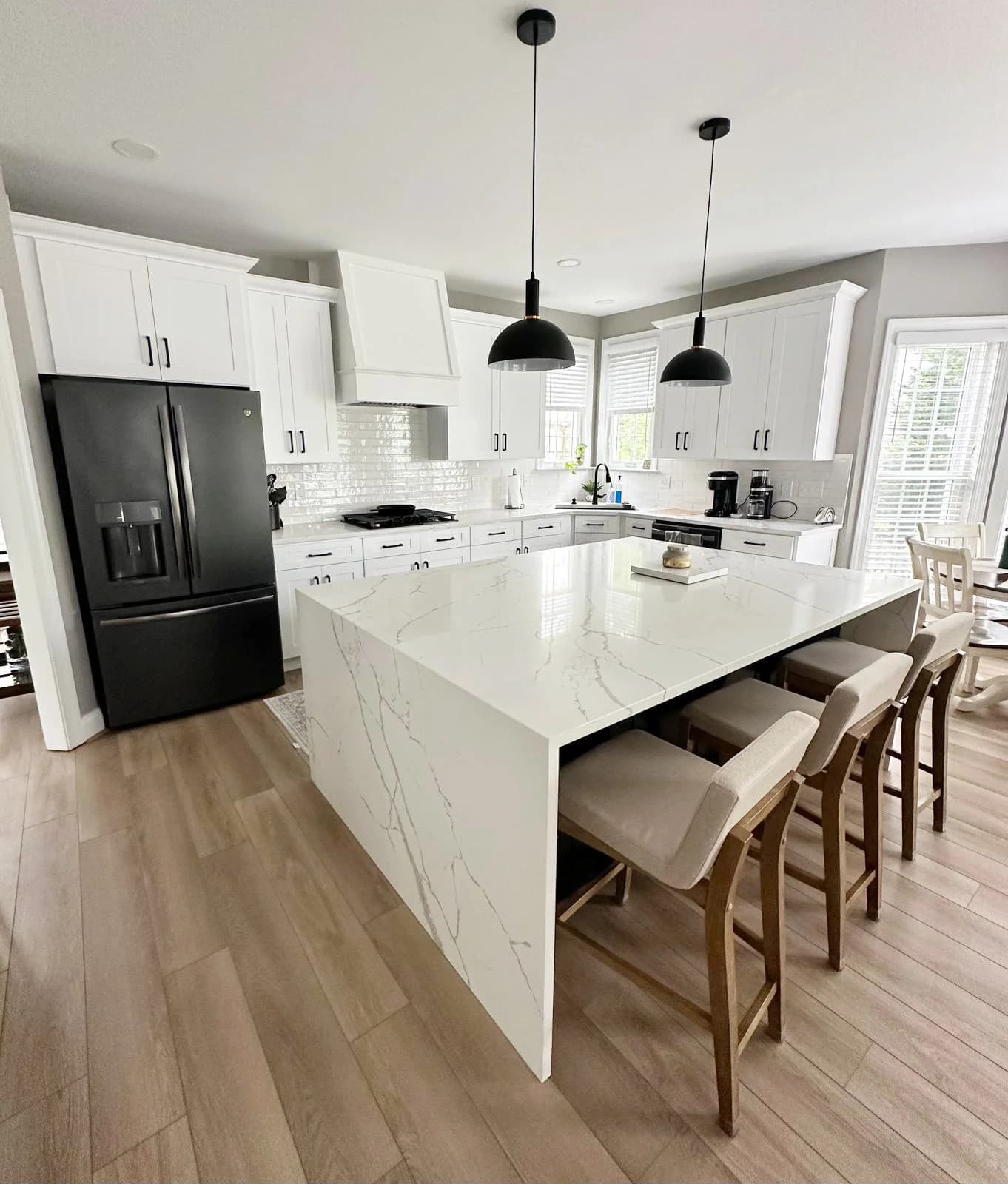
Recent kitchens from our team across Montgomery County, Washington DC and Northern Virginia. Kitchen Remodel in Rockville, MD, White Kitchen Remodel in Washington, DC, and Kitchen Remodel in Fairfax, VA.
Related guides
- Do you need a permit to remodel a kitchen or bathroom? (DC, MD & VA)
- How much a kitchen remodel costs in the DC metro
- Kitchen remodeling in Montgomery County: a local guide
Where we build
Excell Homes remodels homes across the DC metro. Explore our work by area:
This guide is for general information only and is not legal advice. Permit, licensing and lead-safety rules are summarized from each office's published guidance on the dates shown, and they can change. Confirm with the office that governs your address, and the licensing board for your jurisdiction, before you start work.