
Remodeling a Small Bathroom in DC, Maryland or Northern Virginia: Layout, Shower and Storage Decisions
The short answer
A small bathroom remodel succeeds or fails on a handful of decisions made early. The first is whether the toilet, sink and shower stay on the wall where the plumbing already runs. The others are whether the room keeps a tub and where the storage goes. Finishes matter, but in a hall bath, guest bath or powder room they matter less than layout. If the plumbing stays put, most of the budget can go into what you see and use every day. If it moves, the project gets bigger and, in most of the DC area, needs a permit.
What will your project cost?
A few quick questions. See what your budget typically covers. We ask for your name, email and phone before showing the results.
Step 1 of 6
Which room are you remodeling?
What counts as a small bathroom in the DC area?
This guide is about the compact rooms that most houses and condos around here have more of than any other kind: the hall bath shared by the kids' bedrooms, the guest bath, and the powder room tucked off the entry or under the stairs. In Washington, DC that often means a narrow rowhouse bath, or a condo bathroom with fixed walls on every side. In Montgomery County it is often the original hall bath in an older house, with a tub-shower, one sink and not much else.
These rooms have one thing in common: every inch is already in use. There is rarely space to add a fixture, so the remodel is about making the existing footprint work better, not about making it bigger. If you are deciding whether to gain a bathroom instead of redoing one, our guide to adding a bathroom or remodeling the one you have covers that choice.
Should the toilet, sink and shower stay where they are?
Answer this first, because it sets the size of the whole job. In most small bathrooms the fixtures share one "wet wall" where the drain, vent and water lines run. If each fixture stays on its existing drain, the plumber adapts the connections instead of opening the floor and rerouting lines. Moving even one fixture can turn a contained update into a much larger project, sometimes with patching in the room below. A common example is sliding the toilet over to make room for a wider vanity.
Sometimes moving things is worth it. A toilet crammed beside the tub, a door that hits the sink, or a vanity that blocks the only window can be worth fixing for good. For each proposed change, ask: "Does this one move a drain?" If the answer is yes, have it priced separately so you can see what it adds. Our guide to what drives bathroom remodel cost in Montgomery County explains why plumbing location moves the number more than almost anything else, and the same logic applies across the region.
Older homes raise a second issue. Once a small bath is opened up, it is common to find work nobody planned for: an old drain line, soft subfloor from a slow leak, or wiring that can't handle a new fan and lights. Leave room in the budget for it instead of planning for the best case.
Tub, tub-shower or walk-in shower?
In a hall bath, this is usually the biggest design choice after layout. A walk-in shower in the old tub space can make a narrow room feel larger, and it is easier to step into. A tub-shower keeps a place to bathe small children and to soak.
A simple test: if this is the only tub in the house, think hard about who uses it before giving it up. If there is another tub elsewhere, converting this one is usually an easier call. Our tub-to-shower conversion guide explains what the change involves, the choice between a curb and a curbless entry, and when it needs a permit.
Whichever you choose, the enclosure affects how big the room feels. A clear glass panel or door keeps the back wall in view, while a shower curtain cuts the room in half visually. A fixed glass panel with no swinging door can also free up floor space in a tight layout.
Where does the storage go in a small bathroom?
Small bathrooms tend to run out of storage before they run out of anything else. The trick is to use the depth and height of the walls instead of floor space.
- Recess what you can. A medicine cabinet set into the wall, or a niche between the studs, holds as much as a cabinet mounted on the wall without sticking out into the room. Check first: an exterior wall, or the wall that holds the plumbing and vent lines, may not have a usable cavity.
- Plan shower niches with the waterproofing. A built-in shampoo niche beats a caddy, but it has to be designed into the waterproofed wall from the start, not cut in later.
- Choose the vanity for the room, not the showroom. A wall-hung vanity leaves the floor visible underneath, which makes the room look larger and is easier to clean around. A slightly shallower vanity can decide whether the door clears it. Drawers usually hold more usable storage than a cabinet with one shelf.
- Use the wall above the toilet. Open shelves or a shallow cabinet over the tank are one of the few places in a small bath where storage costs you no space.
- Mind the door. A door that swings into a small bathroom takes up a large share of the floor. Ask whether a pocket door, or a door that swings out, would work in your layout and is allowed where you live. A pocket door needs a wall with no plumbing or wiring in the way.
In a powder room, storage is simpler. A small vanity or a console with a shelf, a mirror with some depth, and a spot for a spare roll are usually enough.
How do you make a small bathroom feel bigger?
None of these changes the footprint, but together they change how the room feels.
- Fewer lines on the floor. Larger tiles, or the same tile running from the room into the shower, mean fewer grout lines and a floor that looks like one surface. The shower floor still needs a tile that suits its slope and gives good grip, so it often uses a smaller tile.
- A calm palette. One or two materials used throughout tend to look larger than several that compete. Save the bold tile for a single feature, such as the back wall of the shower.
- Light from more than one place. A single ceiling fixture leaves shadows at the mirror. Light at the vanity plus overhead light gives even light where you actually need it.
- A bigger mirror. A mirror as wide as the vanity reflects light and space back into the room.
Finish level is where you have the most control over cost when the footprint is fixed. The bathroom cost guide explains how much the same small room can vary between standard and custom finishes, so you can decide where spending shows and where it doesn't.
Why does ventilation matter more in a small bathroom?
A small room fills with steam fast. When moisture lingers, it works its way into the paint, the grout and the framing behind the walls. An exhaust fan that is the right size, ducted to the outdoors and actually used does more to protect a new small bath than any single finish. When you get quotes, ask where the fan will exhaust and whether the existing duct will be replaced. A new fan or a new circuit is electrical work, which in most of the region means a permit.
The other two keys to a dry bathroom are good waterproofing behind the shower tile and a shower floor that slopes correctly to the drain. You can't see either once the tile is up, so ask about them before it goes up.
Do you need a permit to remodel a small bathroom?
It depends on what the work touches and where you live. Here is the pattern from the offices we checked. It is summarized from our kitchen and bathroom permit guide, which has the details and sources.
- Surface updates (new paint, floor or countertop) usually go ahead without a permit in Montgomery County, Rockville and Fairfax County, and in DC as long as the house is not in a historic district.
- Moving plumbing or wiring is permit work in every jurisdiction we checked. In DC, Montgomery County and Fairfax County, moving a wall is too.
- Gaithersburg is stricter than the rest of the county. The City treats bathroom remodels as permit work, so check with it before starting even a same-layout update.
- DC is stricter about fixtures. Adding a plumbing fixture needs a permit, and only licensed master trade professionals, not homeowners, can pull the plumbing and electrical permits.
- Montgomery County plumbing permits come from WSSC Water, not from the county's Department of Permitting Services.
- Fairfax County lists bathroom remodels, and new or relocated plumbing fixtures, as permit work.
How should you plan and hire for a small bathroom remodel?
A short checklist that works with any contractor:
- Decide what has to change and what can stay. Write down the three things that bother you most about the room. That list is your brief, not a photo gallery.
- Settle the plumbing question first. Ask each contractor which fixtures stay on their existing drains and what moving any of them would add.
- Ask who pulls the permits and which offices govern your address.
- Compare scope, not just totals. A lower number that leaves out waterproofing, ventilation or the glass is not really a lower price.
- Vet the contractor. Our guide on how to choose and vet a kitchen or bathroom remodeler covers license checks, deposits and contracts in Maryland, DC and Virginia.
A budget is easier to set once the plumbing and tub decisions are made. For how those choices and the finish level move the cost, see the bathroom remodel cost guide. If you plan to finance the work, see our financing options.
Where Excell fits
Excell Homes is a design-build remodeler licensed in Virginia, Maryland and DC. We design the space, handle the permits and build the bathroom under one contract, across Washington, DC, Montgomery County and Northern Virginia. Our team has 20+ years and 2,500+ projects behind it.
You can see recent work in three places:
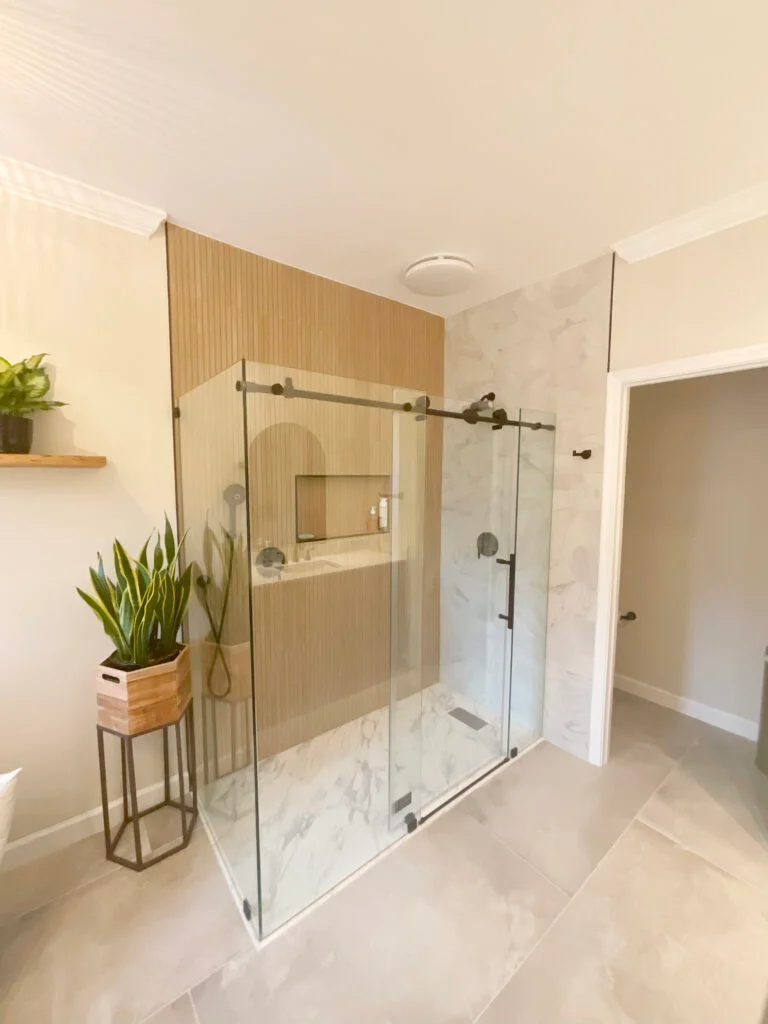
- Washington, DC: a bright, continuous bathroom with a glass-enclosed shower and built-in niches.
- Rockville: the old tub space became a custom shower, for a homeowner on a strict budget.
- Alexandria: a tub-and-shower combo was replaced by a curbless walk-in shower.
There is more on our bathroom remodeling page.
If you're planning a small bath remodel, request a free estimate or call (301) 832-0409.
Frequently asked questions
What is the most important decision in a small bathroom remodel?
Whether the toilet, sink and shower stay on their existing drains. Keeping them in place keeps the project contained and leaves more of the budget for finishes and storage. Moving even one fixture can enlarge the job, and in most of the DC area it turns the job into permit work.
Should I replace the tub with a walk-in shower in a small hall bath?
It depends on who uses the room. A walk-in shower can make a narrow bath feel larger and is easier to step into, while a tub is easier for bathing small children and for soaking. If it is the only tub in the house, think it through; if there is another, converting is usually an easier call.
How can I add storage to a small bathroom without making it feel cramped?
Use the depth and height of the walls instead of floor space. Good options are a recessed medicine cabinet, a shower niche planned into the waterproofing, shelves or a shallow cabinet above the toilet, and a vanity with drawers. Check first whether plumbing, vents or an exterior wall are in the way of anything you want to recess.
What makes a small bathroom look bigger?
Clear glass instead of a shower curtain, floor tile that runs through the room with fewer grout lines, and a calm palette all help. So do a mirror as wide as the vanity and light from more than one source. None of these changes the footprint, but together they change how the room feels.
Do I need a permit to remodel a small bathroom in DC, Maryland or Virginia?
Finish-only work such as paint, flooring and a new countertop generally does not need one in Montgomery County, Rockville, Fairfax County, or DC outside its historic districts. Moving plumbing or wiring needs a permit everywhere we checked. Gaithersburg treats bathroom remodels as permit work, and DC requires a permit for new plumbing fixtures.
Why is ventilation so important in a small bathroom?
A small room fills with steam quickly, and lingering moisture damages paint, grout and the framing behind the walls. A dry bathroom depends on three things: an exhaust fan ducted to the outdoors, good waterproofing, and a shower floor that slopes correctly to the drain. A new fan or circuit is electrical work, which usually needs a permit.
How much does a small bathroom remodel cost?
It depends mostly on whether the plumbing moves, whether the job is a refresh or a full gut, and the finish level. Our bathroom remodel cost guide explains how each of those moves the number. You can only get an accurate figure for your bathroom once someone sees the space.
Recent bathrooms from our team in Washington, DC, Rockville and Alexandria: Marble-Look Bathroom Remodel in Washington, DC, Bathroom Remodel in Rockville, MD, and Bathroom Remodel in Alexandria, VA.
Related guides
- What drives bathroom remodel cost in Montgomery County
- Tub-to-shower conversion: what it involves and when it needs a permit
- Do you need a permit to remodel a kitchen or bathroom?
Where we build
Excell Homes remodels homes across the DC metro. Explore our work by area:
Costs vary with the bathroom, what is behind the walls, and the finishes you choose. Permit rules are summarized from each office's published guidance on the dates shown and are not legal advice; confirm with the office that governs your address before you start work.