
Quartz, Quartzite or Granite Countertops? How to Choose for a DC-Area Kitchen
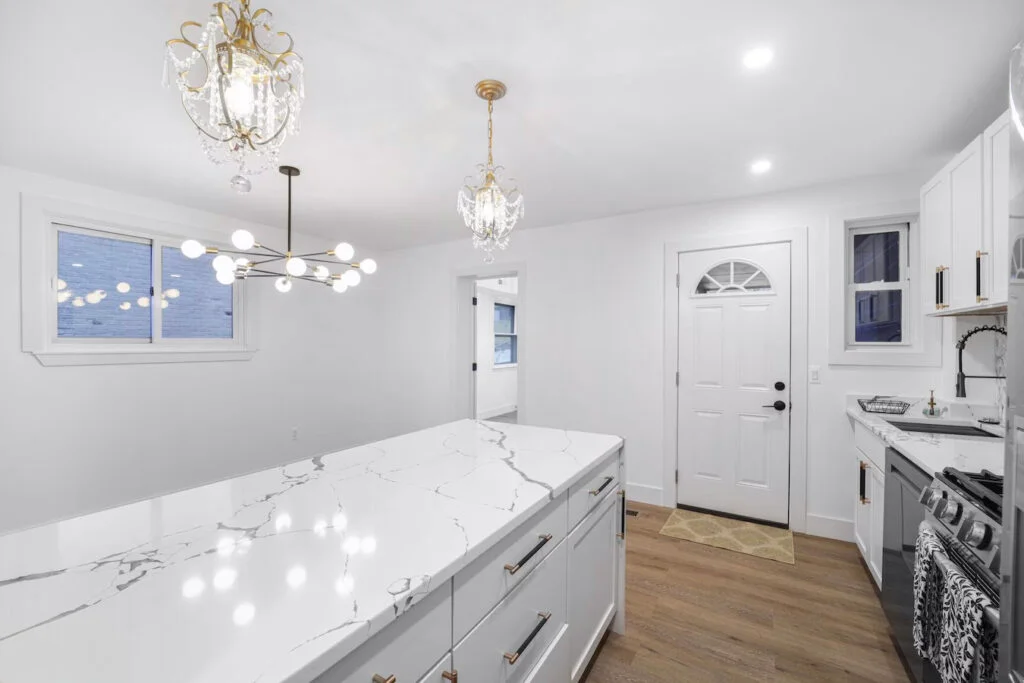
The short answer
Quartz is an engineered slab made in a factory. Quartzite and granite are natural stone cut from a quarry. Quartz gives you a consistent look and a simple daily routine. Quartzite and granite give you one-of-a-kind patterns, but they vary from slab to slab and many need sealing from time to time. None of the three suits every kitchen. Choose based on how you cook and clean, how much sun the counters get and the look you want. Then ask the fabricator for the care sheet for the exact slab you buy.
What will your project cost?
A few quick questions. See what your budget typically covers. We ask for your name, email and phone before showing the results.
Step 1 of 6
Which room are you remodeling?
What's the difference between quartz and quartzite?
The names sound almost the same, which is why "quartz vs quartzite" is such a common question. They are different products.
Quartz countertops are engineered. Manufacturers grind natural quartz, bind it with resin and pigments, and press it into slabs. Each slab is made to a recipe, so color and pattern are predictable, and the showroom sample usually looks like the slab you get. Many quartz products are designed to look like marble, concrete or solid colors.
Quartzite is a natural rock. It starts as sandstone, and heat and pressure turn it into dense stone over a very long time. Slabs are quarried, cut and polished, so every one is different. Quartzite is popular because many slabs have the soft, flowing veining people love in marble, and it has a reputation for being tougher in daily use.
In practice, the choice often comes down to this:
- Lean toward quartz if you want a uniform look, an easy routine and a slab that matches the sample.
- Lean toward quartzite if you want natural stone with a marble-like look and you're willing to inspect slabs in person and follow a care routine.
One caution with quartzite: the name gets used loosely. Some slabs sold as quartzite behave more like marble or other softer stones. That's another reason to see the slab and test a sample before you commit. There's more on that below.
How does granite compare with quartz?
Granite is also natural stone, formed from cooled molten rock. It has been a standard kitchen countertop for decades. It comes in a very wide range of colors and patterns, from fine speckles to dramatic movement.
Compared with quartz, granite generally:
- Looks less uniform. Each slab is unique, which many people like and some find busy.
- Handles heat differently. Natural stone usually tolerates hot cookware better than resin-bound quartz, but sudden temperature changes can still stress any slab. Trivets are a good habit on every surface.
- May need sealing. Many granites are sealed so they resist stains, while some dense ones absorb very little. How often you seal, if at all, depends on the specific stone.
Quartz, in turn, generally:
- Doesn't need sealing under most manufacturers' care instructions, because the resin makes the surface absorb very little.
- Can be sensitive to high heat and strong sunlight. The resin is the weak point. Read the maker's care sheet on hot pans and on strong direct sun (outdoor kitchens, for example) before you commit, and use trivets either way.
If you're weighing quartz vs granite countertops, look at your own habits. If you often set hot pans down without thinking, or your kitchen gets strong afternoon sun, natural stone may be more forgiving. If you want consistent color and a light routine, quartz is a good fit.
Where does marble fit in?
Marble comes up in almost every countertop conversation, so it's worth a quick comparison. It's a natural stone with the classic veined look, but it's softer than granite and most true quartzite. Acidic foods and drinks like lemon juice, wine, tomato sauce and vinegar can etch it, leaving dull marks in the polish. Etching is different from staining, and sealing doesn't prevent it.
Some homeowners accept that wear as patina and choose a honed (matte) finish, which hides etching better than a high polish. Others want the marble look without the upkeep, which is why marble-look quartz and marble-like quartzite are so popular. If you're comparing quartz vs marble, the honest summary is this: marble is the real thing and asks you to live with wear, while quartz is a lookalike that's more forgiving day to day.
Which countertop holds up to heat, stains and scratches?
There's no single winner, and individual products vary widely. Treat this table as a general starting point, not a spec sheet:
| Feature | Quartz | Quartzite | Granite | Marble |
|---|---|---|---|---|
| What it is | Engineered (quartz and resin) | Natural stone | Natural stone | Natural stone |
| Look | Consistent, made to a pattern | Unique, often marble-like | Unique, wide color range | Unique, classic veining |
| Sealing | Usually not needed | Usually recommended | Often recommended | Usually recommended |
| Hot pans | Use trivets; resin can mark | Generally tolerant; still use trivets | Generally tolerant; still use trivets | Generally tolerant; still use trivets |
| Acidic spills | Generally resistant | Varies; some slabs etch | Generally resistant | Etches |
| Strong sun | Some products not advised | Generally fine | Generally fine | Generally fine |
The words "usually," "generally" and "varies" in that table matter. Two granites, or two quartzites, can behave very differently. Before you decide, ask the fabricator for the care sheet for the specific slab or product you're considering. Follow it over general advice from the internet, including this article.
Every one of these surfaces needs some care. Any countertop will last longer if you wipe spills promptly, use cutting boards and trivets, and clean with products the maker approves.
How do you check a stone slab before you commit?
With natural stone, you're buying a specific slab, not a color name. A few steps help:
- See the actual slab. Ask to see the full slab or slabs your countertop will come from, not just a small sample. Veining and color can shift a lot across one slab.
- Ask where the seams will go. Large islands and L-shaped runs often need seams. Ask the fabricator to show you where they'll fall and how the pattern will line up.
- Take a sample home. Look at it in your own light, next to your cabinet door and flooring samples.
- Test an offcut, with permission. Many fabricators will let you put a drop of lemon juice or vinegar on a scrap piece to see if it etches. You can also leave a little cooking oil on it to see whether it darkens. This is especially useful for quartzite, given how loosely the name is used.
- Ask about finish and edge. Polished, honed and textured finishes look and wear differently. The edge profile affects both looks and chipping.
- Get the care sheet in writing. Ask which cleaners to use, whether and how often to seal, and what to avoid.
With quartz, the main checks are that the slab color matches the sample, what the manufacturer says about heat and sun, and where the seams will go.
How does the countertop choice fit with the rest of the kitchen?
Countertops come late in the sequence. The fabricator usually measures (templates) after the base cabinets are set, because the stone has to fit the cabinets exactly. That's why it pays to settle the layout, appliances and cabinets first. Our guide to what not to do in a kitchen remodel explains that order and why getting it wrong costs money.
If you're keeping your existing cabinets, make sure the boxes are sound and level before heavy stone goes on them. Our guide on whether to reface, paint or replace kitchen cabinets explains how to check the boxes. If new counters are part of a cabinet update, ask how the two jobs will be sequenced.
A few related choices belong in the same conversation:
- Sink and cooktop. Undermount sinks and cooktops need cutouts in the slab, so choose those models before templating.
- Backsplash. Running the countertop slab up the wall as a full-height backsplash is a popular look. It uses more material and needs careful planning around outlets and windows.
- Bathrooms. The same quartz-versus-stone tradeoffs apply to bathroom vanity countertops, just on a much smaller piece.
Do you need a permit to replace kitchen countertops?
Usually not, if the countertop is the only thing changing. Our kitchen and bath permit guide summarizes what each local office had published as of October 2026. Fairfax County includes kitchen countertops on its list of work that doesn't need a permit. The picture is generally the same in Montgomery County, Rockville, and DC outside its historic districts.
The exceptions usually come from other parts of the project:
- Moving the sink or adding plumbing, gas or wiring turns the job into permit work in every jurisdiction the guide covers.
- In Fairfax, appliances can trigger a permit on their own. The county treats replacing a stove or oven as permit work. It also requires a permit to install or replace any gas appliance, even a like-for-like swap. If your new countertop comes with a new gas cooktop, check first.
- Gaithersburg requires a Residential Improvement Permit for kitchen remodeling, and DC's permit-free list doesn't apply inside historic districts.
Rules change, so confirm with the office that covers your address before work starts.
How does the material affect your budget?
Countertops are one line in a kitchen budget, not the whole story. Prices vary as much within each material as between them. A common granite can cost less than a premium quartz, and a rare quartzite can cost more than either. Beyond the slab itself, the total depends on:
- the size and thickness of the countertops
- the number of seams
- the edge profiles
- sink and cooktop cutouts
- how hard the stone is to cut and finish
Very hard natural stones can take more fabrication work.
For how countertops fit into a whole kitchen budget, see our kitchen remodel cost guide for the DC metro. When you compare quotes, ask each fabricator or contractor to itemize the slab, fabrication, edges, cutouts, installation and removal of the old countertops. That way you're comparing like with like.
Where Excell fits
Excell Homes is a design-build remodeler for full kitchen remodels, and our kitchen work includes quartz, quartzite, granite and marble countertops. Design, permitting and construction are covered by one contract. We work across Washington, DC, Montgomery County and Northern Virginia, with 20+ years and 2,500+ projects behind us, and we're licensed in Virginia, Maryland and DC. Recent work includes a white kitchen in Washington, DC with a quartz waterfall island and wood slat detailing. Another is a walnut kitchen in Washington, DC with marble countertops and a marble backsplash. To talk through your kitchen, contact us or call (301) 832-0409.
Frequently asked questions
What is the difference between quartz and quartzite?
Quartz countertops are engineered: ground quartz is bound with resin and pigments and pressed into slabs, so the look is consistent. Quartzite is a natural stone formed from sandstone under heat and pressure, so every slab is unique. Quartz usually doesn't need sealing, while quartzite usually does.
Is quartz or granite better for a busy kitchen?
It depends on your habits. Granite is natural stone that generally tolerates hot cookware better, but it may need periodic sealing. Quartz generally needs no sealing and has a consistent look, but its resin can be sensitive to high heat and strong sun. Ask for the care sheet for the specific product before you decide.
Do quartzite countertops need to be sealed?
Many quartzite slabs are sealed so they resist stains, but how often depends on the specific stone. Some slabs sold as quartzite behave more like softer stones, so ask the fabricator for that slab's care sheet. If they allow it, test an offcut with a little lemon juice and oil.
Can you put hot pans on quartz countertops?
Check the slab maker's care sheet first, because the resin that binds quartz can mark from high heat. Natural stones are generally more tolerant, but sudden temperature changes can stress any slab. Using trivets on every countertop is the safest habit.
How does quartz compare with marble?
Marble is a natural stone with classic veining, but it's softer and acidic foods like lemon juice, wine and vinegar can etch it. Sealing helps with stains but doesn't prevent etching. Marble-look quartz gives a similar appearance and is more forgiving day to day.
Do I need a permit to replace kitchen countertops in Fairfax County?
Usually not, if only the countertop is changing. Fairfax County lists kitchen countertops as work that doesn't need a permit. Moving plumbing, gas or wiring does need one, as does installing or replacing a gas appliance such as a cooktop. Confirm with the county before work starts.
How much do quartz, quartzite and granite countertops cost?
Prices vary as much within each material as between them. Slab size, seams, edges, cutouts and how hard the stone is to fabricate all change the total. For how countertops fit into a whole kitchen budget, see Excell Homes' kitchen remodel cost guide for the DC metro, and ask for itemized quotes.
Recent kitchens from our team in Washington DC and Rockville, including a quartz waterfall island and marble countertops with a marble backsplash. White Kitchen Remodel in Washington, DC, Walnut Kitchen Remodel in Washington, DC, and Kitchen Remodel in Rockville, MD.
Related guides
- How much a kitchen remodel costs in the DC metro
- Do you need a permit to remodel a kitchen or bathroom? (DC, MD & VA)
- How to choose and vet a kitchen or bathroom remodeler
Where we build
Excell Homes remodels homes across the DC metro. Explore our work by area:
This guide is for general information only and is not legal advice. Permit rules are summarized from each office's published guidance as of November 2026, and they can change. Countertop care varies by product and by slab, so follow the care sheet from your fabricator or manufacturer, and confirm permit needs with the office that governs your address before you start work.